Gathering What’s Already Known
Search before you generate
Before you build a survey, run a test, or spend a dollar to learn something, ask a cheaper question first: does someone already know this? A great deal of what an entrepreneur needs has already been gathered, counted, or lived through by someone else. The market’s rough size, the going price, the shape of the competition, the hard-won lessons of the people who came before: much of it sits in plain sight, free or nearly free, waiting for anyone who thinks to look. This is secondary evidence, and the first move in gathering evidence is not to make new signal. It is to find the signal that already exists.
Secondary evidence — anything already gathered by someone else, for their own purpose, that you can look up rather than generate. Its opposite, primary evidence, you produce yourself: the subject of the next chapter.
This is the cheap half of gathering evidence, which comes in two moves. First you gather what already exists; then you test what doesn’t. Searching for secondary evidence is that first move (the reading, the asking, the desk work) and it comes first for a plain reason. It is the fastest and least expensive evidence you will ever get. To skip it is to pay full price, in time and money, for answers you could have had for the cost of an afternoon.
But cheap evidence is usually weak evidence
Here is the catch, and it runs through everything in this chapter. Secondary evidence is cheap precisely because someone gathered it for their own purpose, at another time, about someone other than your customer. That is also its ceiling. Most of what you can look up is what people said in opinions, surveys, and stated intentions, or numbers so aggregated that your particular question vanishes into the average. The strongest evidence is not what people say but what they do, and what your customers will do, in your market, almost never sits waiting on a shelf. You usually have to go make it.
So hold a clear expectation for this first pass. Gathering what’s known is the work of orienting. It sizes the opportunity, sharpens your prior, and rules out the obviously wrong. Most valuable of all, it tells you exactly what you still don’t know. It is rarely enough to let you commit. Treat it as the map you study before the expedition, not the ground you learn by walking.
And keep one distinction sharp. Some of what you don’t know, someone else already does; searching closes that gap, carrying you up to the frontier of what the world collectively knows. But it cannot take you past that frontier, to what no one knows yet. That is genuine uncertainty — and it is not a flaw in your research but the very place opportunity lives. Gathering what’s known can only bring you to its edge and show you where it begins.
A short tour, weakest to strongest
It helps to line the sources up in a single order, from the ones that only tell you what people said to the ones that show you what they did. The climb is the point. Each step costs a little more effort and returns a little more truth, and the top of what’s already known sits just below the evidence you will have to generate yourself.
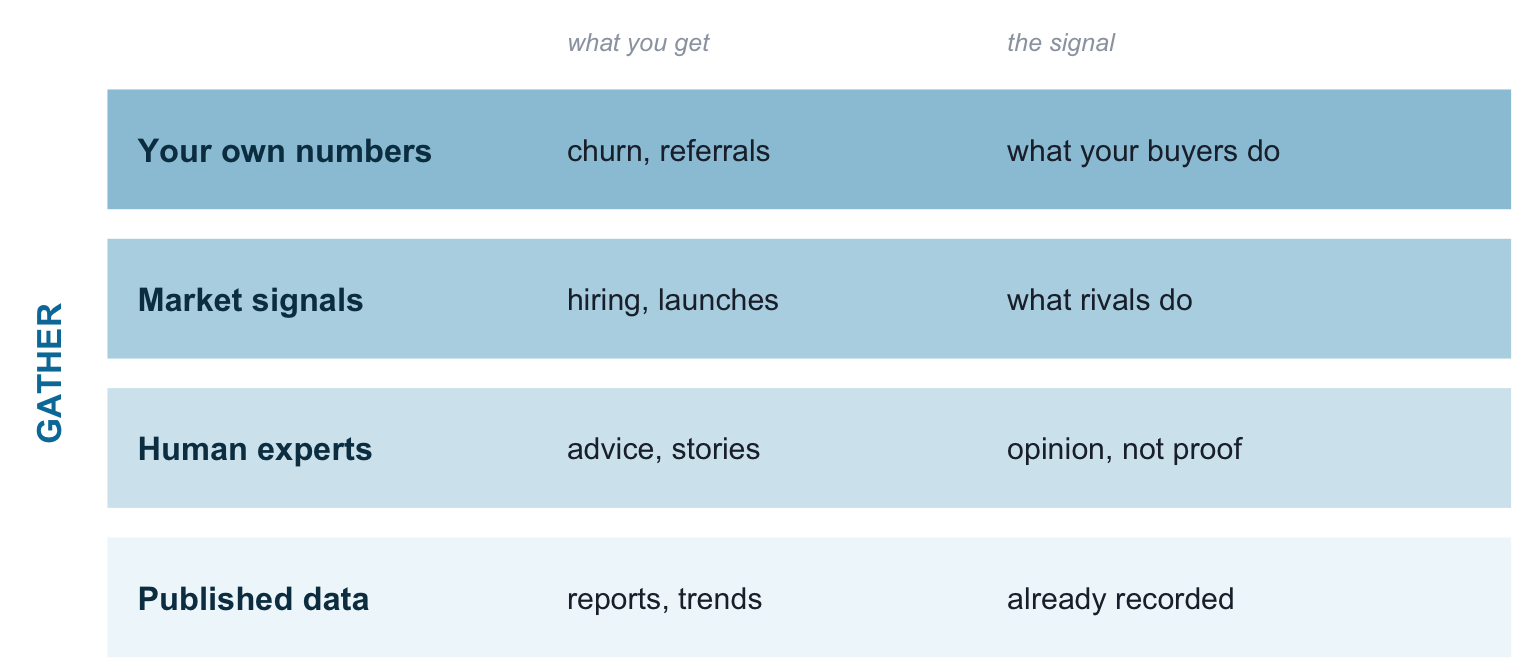
Published data. Start at your desk. Governments, trade groups, universities, and data vendors have already counted most of what you’d want to know about a market’s size, its trends, and its money. Some of it is free, a public radar screen you can scan in an afternoon; the rest sits behind a library login or a subscription. It is wide, not deep: it will tell you how big the pond is, never whether these particular fish are biting. Use it to set bounds, not to manufacture false precision. A range from a solid source beats a single confident number from a hopeful one. And mind two traps. The figures may be older than they look, and an average can bury the very niche you care about.
Human experts. Faster than any dataset is a person who has spent a career in your space. An hour with a veteran can hand you years of pattern recognition, context, and warnings you would never find written down. But an expert supplies hypotheses, not verdicts. Confidence is not accuracy, and everyone carries the biases of where they have been. The move that turns opinion into something firmer is to ask for stories, not advice. “Tell me about the last time you saw this go wrong” pulls out what they actually did and saw; “Do you think this will work?” only pulls out a guess in a confident voice.
Market and competitor signals. Now the ground firms up, because here you read what firms do, not what anyone says. Competitors and markets leave tracks. Watch the jobs they post, the prices they change, the patents they file, the reviews their customers leave. These are weather vanes, and reading them lets you trim your sails before the storm. A rival suddenly hiring last-mile logistics coordinators is telling you something about delivery costs that no press release will. Two disciplines keep it honest. Weigh only the signals that are relevant, repeatable, and actionable, and trust them most when several point the same way. A single blip is noise; a cluster is a message.
Your own numbers. The strongest evidence that can already exist is what your own venture throws off. It is the record of what customers actually do once they meet you, whether they buy again, cancel, or refer a friend. This is behavior, not opinion — the mirror that doesn’t flatter. Its one limit is timing. This evidence exists only once you are operating, so it is cheap and abundant for an established business and simply absent before launch; the founder still deciding whether to begin has an empty mirror. But the moment you have traffic, sales, or usage, read it as feedback, not bookkeeping. It is the closest thing to truth you can get without running a deliberate test.
Notice where the climb ends. The best evidence is behavioral, and behavioral evidence reaches you in exactly two ways: you harvest it from something you are already running, or you generate it on purpose with an experiment. Everything in this chapter is the harvest. The reason the next chapter is the hard and essential one is that the behavior you most need to see usually hasn’t happened yet — and to see it, you have to cause it.
Halo Alert — the cheap first pass
Before the Halo Alert team spent a dollar generating evidence, there was much they could simply look up. Published data told them how common the fear is. Gallup’s crime survey, which has tracked it since the 1960s, finds that roughly half of women name a place near home where they are afraid to walk alone at night.1 An hour with a former 911 dispatcher gave them hypotheses about when fear actually spikes that no survey would surface. Market signals showed which device makers were hiring and shipping, and what their reviewers complained about. None of it proved the idea. All of it sharpened the prior and narrowed the question, so that when they finally did spend on a test of their own, they spent it on the one thing the desk work could never tell them: whether these people would actually wear the thing.
Know when to stop looking
Searching what’s known has a natural end. You have gathered enough when the cheap sources stop changing your mind, when the next report, the next expert call, the next competitor scan only confirms what you already have.2 That is the edge of what is knowable without spending, and the questions still standing at that edge can only be answered by generating evidence of your own. Push past it and you are no longer researching; you are stalling.
Trap to Avoid — “Generating what you could have found”
The costly mistake in this chapter is not over-trusting your desk research; it is skipping it. Founders routinely build a feature, run a survey, or launch a test to learn something a competitor’s pricing page or a public dataset would have told them in ten minutes. Generating evidence is expensive; borrowing it is nearly free. Spend your scarce budget for making evidence only on the questions no one has already answered. Find out which those are by looking first.
Working with your AI
Working with your AI — where you step in
Gathering what’s known is the most automatable work in this whole book, and you should let your AI carry most of it. But the mechanics are the part to hand off — not the judgment.
- Send it to search. Have it pull the base rates, size the market, scan competitors’ tracks, and summarize what the reports and the experts already say. This wide, borrowed, said-heavy work is exactly what it does fastest.
- Keep the trust decision. The AI will hand you numbers with equal confidence whether they are solid or stale. You decide what to believe: which source is current, which average hides your niche, which expert has an agenda.
- Ask what’s still unknown. The point of the search is to find the edge of it. Have it list, plainly, which of your questions the existing evidence cannot answer. Those are the ones worth generating evidence for.
Ask Your AI
Here is the decision I’m facing and what I’m trying to learn: [describe it]. Before I spend anything gathering new evidence, do a search of what already exists: market size and trends, competitor moves and pricing, relevant public or industry data, and what domain experts generally say. Summarize what it suggests, flag how much I should trust each piece and how current it is, and then tell me plainly which of my questions the existing evidence can’t answer.
Putting It to Work
Try This — Search before you spend
Take a question you were about to answer by building or testing something.
- Before you spend a dollar, list where that answer might already exist: public data, a paid report, an expert you could call, a competitor already doing it, your own numbers.
- Give yourself one afternoon to gather what you can from those.
- Write down what you learned — and, more importantly, what you still don’t know.
- That short list of the still-unknown is your real research agenda. It is the only thing worth spending to generate.
The move: Search before you generate. Exhaust the cheap, already-existing evidence to sharpen your prior and find the edge of what you don’t know. Then spend your scarce budget for making evidence only on the questions no one has answered yet.
You have gathered what the world already knows. You have the reports, the veterans’ warnings, the tracks your rivals left, and the numbers in your own mirror. It has cost you little and told you much — most of all, it has told you where the known evidence runs out. That edge is where this part of the book turns. Everything you couldn’t look up, everything that comes down to what your customer will actually do, you will now have to find out the harder way: by designing an experiment and generating the evidence yourself.
Gallup, “Personal Safety Fears at Three-Decade High in the U.S.” (2023) and subsequent Crime polls: about 53% of U.S. women, versus 26% of men, name an area within a mile of home where they would be afraid to walk alone at night. https://news.gallup.com/poll/544415/personal-safety-fears-three-decade-high.aspx↩︎
Researchers in other fields meet this same idea under other names: theoretical saturation in qualitative research (you stop sampling when new data stop yielding new categories), falling information entropy in information theory, and diminishing value of information in decision analysis. When surprise stops arriving, you already know most of what you are going to learn.↩︎