Exploring
Building the ground a hypothesis can stand on
You have your urgent unknown. Sometimes it arrives already sharp — a clean question you could state as a claim and test tomorrow. More often it arrives fogged, too big or too strange to phrase without guessing at half the words. And a hypothesis built on a guess is not a hypothesis; it is a hope with a hypothesis’s grammar. When the question is still that unformed, you are not ready to test it. You are ready to look.
That looking is exploration, and it is the second move of framing. It is what you do when you do not yet know enough to ask a good question, let alone answer one.
The groundedness threshold
A hypothesis cannot be plucked from thin air. To be worth testing, it has to rest on some real understanding of the thing it is about — call that groundedness, the amount of genuine contact with reality behind a belief. A belief with high groundedness is built from things you have actually seen or lived through; one with low groundedness is built from what you assume, hope, or half-remember.
Groundedness — how much real contact with the world a belief rests on. Low groundedness is a hunch; high groundedness is a claim shaped by what you have actually seen, heard, or lived.
Framing has a threshold hiding in it. When your uncertainty about an unknown runs well ahead of what you have actually seen, any hypothesis you write is a guess, and testing it wastes a real experiment on a made-up question. As observation accumulates and the shape of the answer starts to show, you cross into territory where a hypothesis is finally worth testing. Exploration is simply the work of crossing that threshold, of trading assumptions for observations until you know enough to ask something sharp. You do not explore forever; you explore until the question comes into focus, and then you stop.
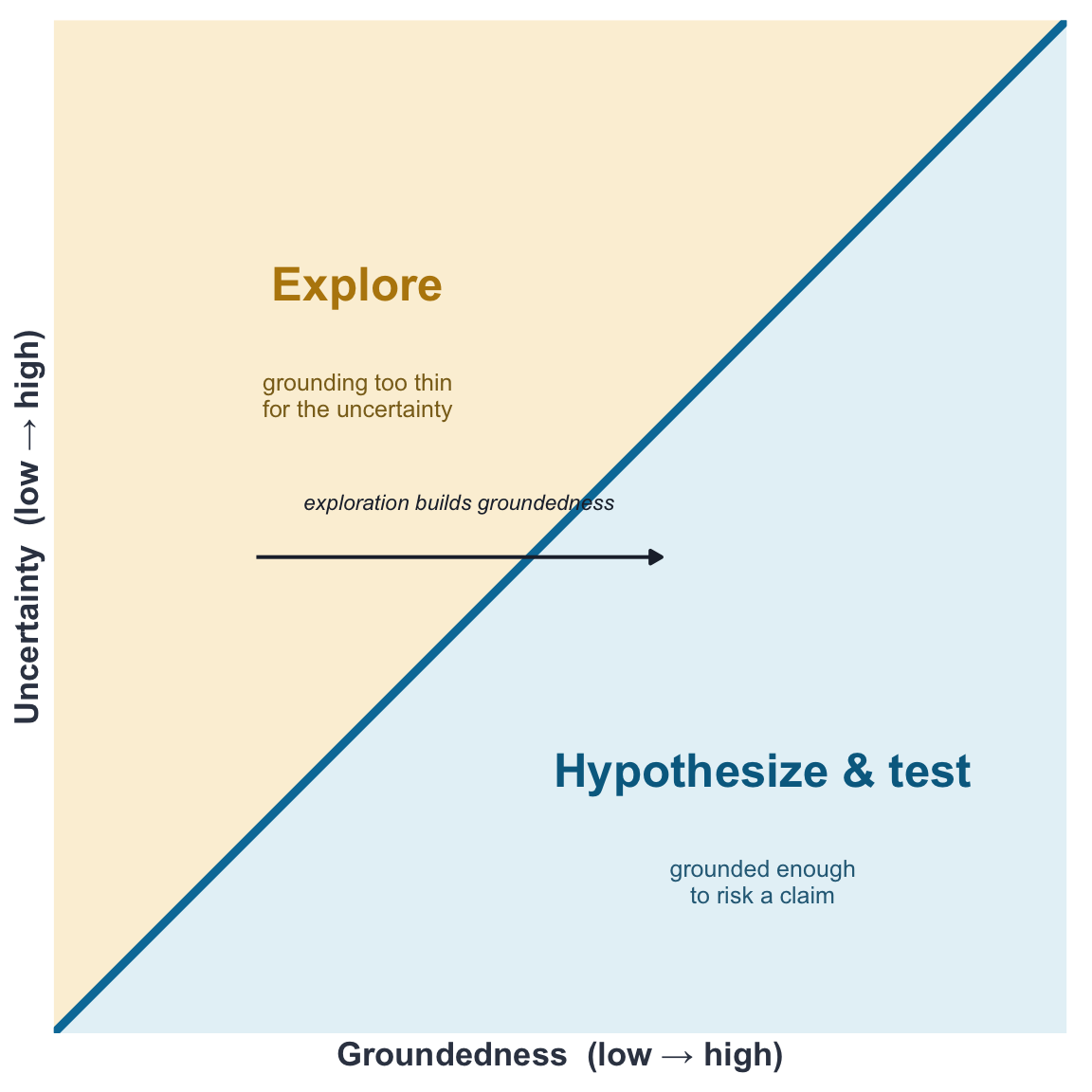
What exploring looks like
Exploration is structured wandering. The philosopher Ian Hacking called this kind of inquiry adventure (2006): deliberately stepping into the world to experience it and let it reshape your beliefs, rather than to confirm the ones you walked in with. You go out without a hypothesis on purpose, because a hypothesis this early would only tell you what to ignore.
Exploration takes a few familiar forms, and most mix them.
- Observation. Watch how people actually behave, in their world rather than your survey. What they do rarely matches what they would tell you.
- Conversations. Ask open questions and follow the answers, without pitching. The moment you start selling, you stop learning.
- Probes. Small, cheap trials that prove nothing on their own but surface patterns — a fake landing page, a hand-made prototype passed to five people.
- Secondary research. The reports, datasets, and public sources that let you stand on what is already known before you go looking for what isn’t.
None of these hands you a clean answer. What they hand you is raw material: surprises, offhand comments, things that don’t fit. And it is the things that don’t fit that matter most. For a fuller toolkit of exploration methods, the companion book Expeditionary Innovation goes deep on ethnographic exploration and structured ways to turn what you find into hypotheses.
How to explore well
Wandering on purpose has a shape. Go wide before you narrow, resisting the urge to filter down to what confirms your idea. Hunt for anomalies, because the strange remark or the behavior you did not predict is usually where the real frame is hiding. Write everything down (notes, quotes, photos) and do not trust your memory, which will quietly rewrite the trip to match whatever you conclude. Then step back and look for themes across it all. And at each pass, ask the threshold question: do I now understand this well enough to state a claim I could be wrong about? If the answer is no, you have not failed; you have simply learned that you need one more round. If the answer is yes, exploration has done its job, and the next move is the leap from what you noticed to what you will test.
Watch, especially, for the surprise that does not just add to your picture but breaks it — the signal that the frame you walked in with is the wrong frame entirely. Exploration is the richest source of those, and when one arrives, it is not a nuisance to explain away. It is the revision that saves you from testing, at great cost, a question that was never the right one.
Halo Alert — what the looking turned up
Before the Halo team could write a testable question, they went and looked. They talked with women about safety, unpitched, and spent an hour with a former emergency dispatcher. They had walked in with a tidy frame: women feel unsafe, a wearable panic button would help, so the question is which features to build.
The looking broke that frame. Woman after woman said the same unprompted thing — that the phone, the obvious safety tool, is the first thing an attacker grabs or knocks away, and that reaching for it openly can make you more of a target, not less. That was the anomaly, and it did not fit the “build a better panic button” story. It pointed somewhere sharper: the real unknown was not whether women wanted safety, but whether a discreet, hands-free signal was worth switching to over the phone already in their pocket. That reframed question was grounded, it came straight from what they had heard, and it was finally sharp enough to test. The exploration had carried them across the threshold.
Working with your AI
Working with your AI — where you step in
Your AI can do a real share of exploration and none of the part that matters most, which is being there. Use it for reach and pattern, and go into the world yourself for the rest.
- Hand it the secondary research. It is fast and tireless at the reports, datasets, and prior art that tell you what is already known, so your own looking starts where the map runs out.
- Let it find patterns in your notes. Feed it your observations and quotes and ask what themes and anomalies recur. It has no ego invested in your original idea, so it will surface the surprise you are tempted to explain away.
- Do the looking yourself. The AI cannot watch your customer flinch, hear the thing they almost didn’t say, or feel that a story doesn’t add up. Primary contact with reality is yours; that is the whole point of exploring.
Ask Your AI
I’m exploring this urgent unknown before I try to write a hypothesis: [state it]. First, tell me what’s already known from public sources so I don’t waste field time rediscovering it. Then here are my raw notes from watching and talking to people: [paste them]. What patterns and, especially, what surprises or anomalies do you see — including anything that suggests the frame I started with is wrong? Don’t smooth them away; point at the ones that don’t fit.
Putting It to Work
Try This — Run a micro-exploration
Take the urgent unknown you framed, and spend one hour building ground under it.
- Pick the people or setting closest to the unknown, and go watch or talk to them for an hour — without pitching anything.
- Write down three things that surprised you, especially anything that did not fit what you expected.
- Ask the threshold question: do these surprises give you enough to state a claim you could be wrong about?
- If yes, turn one surprise into a possible explanation, and draft a hypothesis you could test next week. If no, name exactly what is still missing and plan one more short round.
Done honestly, one hour will move you further than a week of guessing at your desk — from fog, to a surprise, to a signal solid enough to build a real question on.
The move: When the question is too fogged to test, don’t force a hypothesis — go look. Explore until real observation has carried you over the threshold where a claim worth testing becomes possible, following the surprises that don’t fit, because that is where the true frame hides.
Exploration ends with something in your hand: a surprise, a pattern, a signal that the frame you started with was not quite right. What it does not yet give you is a claim. Turning a signal into a sharp, testable hypothesis, making the leap from I noticed this to I bet that, is a move with a name and a logic of its own, and it is the last step of framing before the world gets to answer back. That is where we turn next.